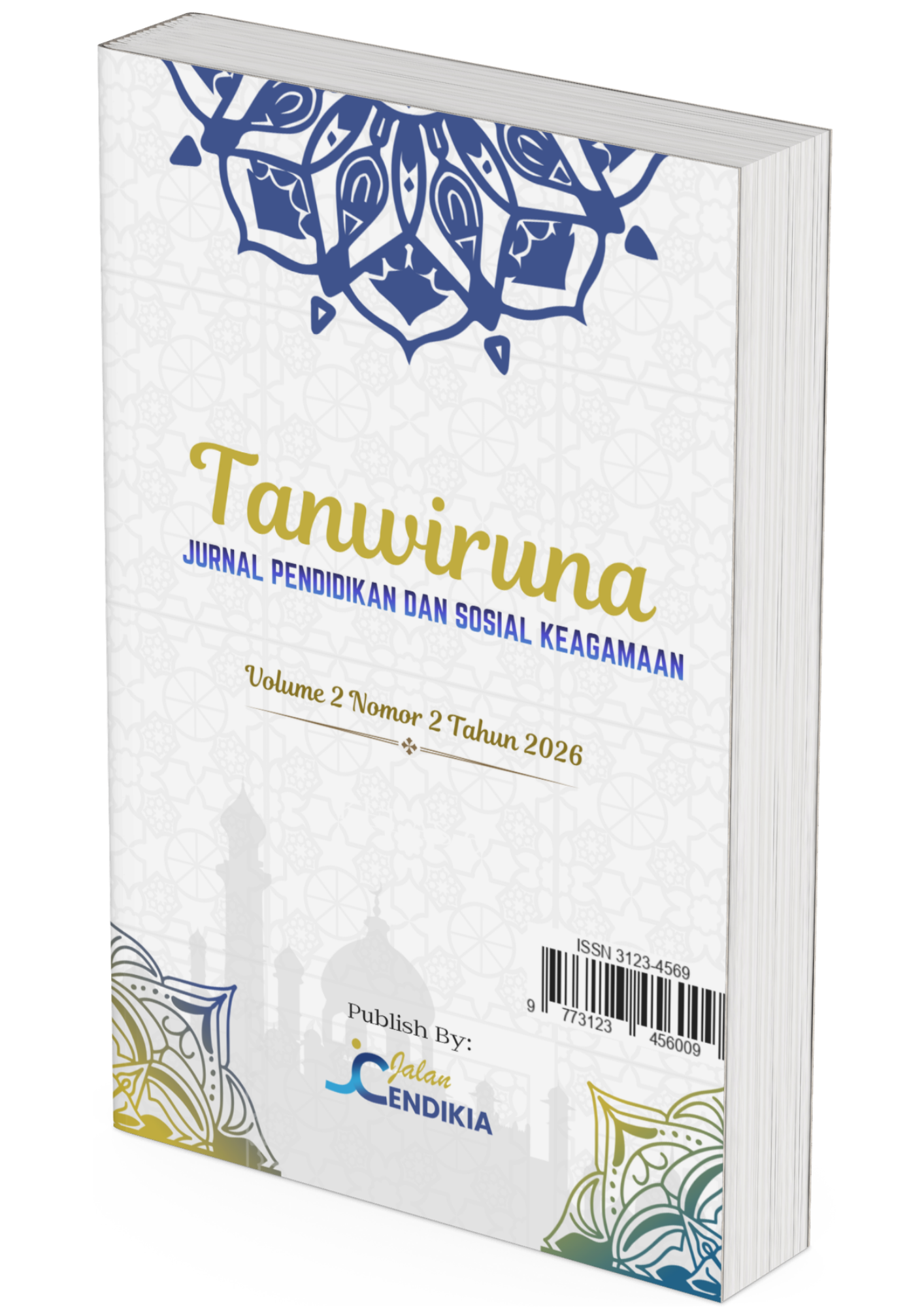
Pengaruh Peer Teaching Terhadap Pengembangan Kompetensi Pedagogis Calon Guru Pendidikan Agama Islam
DOI:
https://doi.org/10.65793/j.tanwiruna.2026.50Keywords:
peer teaching, kompetensi pedagogis , calon guru, Pendidikan Agama Islam, pembelajaran kolaboratifAbstract
Dalam dunia Pendidikan saat ini peer teaching merupakan salah satu model pembelajaran yang digunakan untuk meningkatkan kompetensi pedagogis calon guru, misalnya guru Pendidikan agama islam. Yang mana guru berperan penting dalam mengajarkan pengetahuan, keterampilan dan pengalaman. Metode pembelajaran ini memungkinkan calon guru dapat berdiskusi dengan aktif, kooperatif, dalam model ini calon guru berperan sebagai pembimbing jalannya sebuah pembelajaran dalam diskusi belajar siswa. Penelitian ini bertujuan untuk mengetahui sejauh mana kemampuan calon guru dalam memahami dan mengajarkan siswa untuk meningkatan hasil belajar peserta didik. Metode yang digunakan adalah metode kuantitatif, yang mana peneliti memanfaatkan sebagai pemandu agar fokus penelitian sesuai dengan fakta dilapangan dan data yang berisikan angka dengan cara menggunakan Google-form sebagai sarana membuat angket, pertanyaan yang diberikan kepada respoden yang dapat dijadikan sebagai subjek peneltian. Berdasarkan hasil penelitian menunjukkan bahwa metode pembelajaran peer teaching dapat membantu calon guru untuk meningkatkan pemahaman peserta didik dalam proses pembelajaran.
References
Buchanan, J. A. G., & Parry, D. (2019). Engagement with peer observation of teaching by a dental school faculty in the United Kingdom. European Journal of Dental Education, 23(1), 42–53. https://doi.org/10.1111/eje.12391
Carstensen, B., & Klusmann, U. (2021). Assertiveness and adaptation: Prospective teachers’ social competence development and its significance for occupational well-being. British Journal of Educational Psychology, 91(1), 500–526. https://doi.org/10.1111/bjep.12377
Cumberworth, J., Apperley, H., & Francis, I. (2020). Organising near-peer teaching programmes for clinical professionals. The Clinical Teacher, 17(2), 122–125. https://doi.org/10.1111/tct.12983
De Brún, A., Rogers, L., Drury, A., & Gilmore, B. (2022). Evaluation of a formative peer assessment in research methods teaching using an online platform: A mixed methods pre-post study. Nurse Education Today, 108, 105166. https://doi.org/10.1016/j.nedt.2021.105166
Harrison, C. H., Elmansouri, A., Parton, W., Myers, M. A., Hall, S., Stephens, J. R., Seaby, E. G., & Border, S. (2019). The Efficacy of Frontline Near-Peer Teaching in a Modern Medical Curriculum. Anatomical Sciences Education, 12(3), 236–244. https://doi.org/10.1002/ase.1827
Heponiemi, T., Kaihlanen, A.-M., Kouvonen, A., Leemann, L., Taipale, S., & Gluschkoff, K. (2022). The role of age and digital competence on the use of online health and social care services: A cross-sectional population-based survey. DIGITAL HEALTH, 8, 205520762210744. https://doi.org/10.1177/20552076221074485
Jenkins, E., D’Aoust, R., Elias, S., Han, H. R., Sharps, P., & Alvarez, C. (2021). Faculty peer review of teaching taskforce: A quantitative descriptive research study for the peer review process. Nurse Education Today, 106, 105055. https://doi.org/10.1016/j.nedt.2021.105055
Junge, K., Schmerse, D., Lankes, E.-M., Carstensen, C. H., & Steffensky, M. (2021). How the home learning environment contributes to children’s early science knowledge—Associations with parental characteristics and science-related activities. Early Childhood Research Quarterly, 56, 294–305. https://doi.org/https://doi.org/10.1016/j.ecresq.2021.04.004
Karamaroudis, S., Poulogiannopoulou, E., Sotiropoulos, M. G., Kalantzis, T., & Johnson, E. O. (2020). Implementing Change in Neuroanatomy Education: Organization, Evolution, and Assessment of a Near-Peer Teaching Program in an Undergraduate Medical School in Greece. Anatomical Sciences Education, 13(6), 694–706. https://doi.org/10.1002/ase.1944
López-Meneses, E., Sirignano, F. M., Vázquez-Cano, E., & Ramírez-Hurtado, J. M. (2020). University students’ digital competence in three areas of the DigCom 2.1 model: A comparative study at three European universities. Australasian Journal of Educational Technology, 69–88. https://doi.org/10.14742/ajet.5583
Lucas, M., Bem-Haja, P., Siddiq, F., Moreira, A., & Redecker, C. (2021). The relation between in-service teachers’ digital competence and personal and contextual factors: What matters most? Computers & Education, 160, 104052. https://doi.org/https://doi.org/10.1016/j.compedu.2020.104052
Mauliandari, R., Sumarwati, M., & Upoyo, A. S. (2020). Peer Learning: An Effective Teaching-Learning Method for Improving Ability in Arterial Blood Gases Interpretation. Nurse Media Journal of Nursing, 10(3), 329–338. https://doi.org/10.14710/nmjn.v10i3.28660
Rudinsky, S. L., Spalding, C., Conley, S. P., Everett, L., & Cole, R. (2022). The development, implementation, and evaluation of a medical student peer teaching training curriculum during a high-fidelity prehospital trauma simulation. AEM Education and Training, 6(4), e10782. https://doi.org/10.1002/aet2.10782
Seifert, L., Manap, A., Sterz, J., Gerlach, F., & Sader, R. (2020). A Comparison Between Virtual Patient and Peer-Assisted Learning in Teaching Basic Medical Knowledge and Skills. Electronic Journal of E-Learning, 18(1). https://doi.org/10.34190/EJEL.20.18.1.004
Thom, M. L., Kimble, B. A., Qua, K., & Wish-Baratz, S. (2021). Is remote near-peer anatomy teaching an effective teaching strategy? Lessons learned from the transition to online learning during the Covid-19 pandemic. Anatomical Sciences Education, 14(5), 552–561. https://doi.org/10.1002/ase.2122
Tomita, K. (2021). Constraints on Instructional Media Design: How Do Media Developers Deal with Them? Performance Improvement Quarterly, 34(2), 171–193. https://doi.org/10.1002/piq.21344
Yıldırım, T., & Canpolat, N. (2019). An Investigation of the Effectiveness of the Peer Instruction Method on Teaching about Solutions at the High-School Level. TED EĞİTİM VE BİLİM. https://doi.org/10.15390/EB.2019.7966
Zayyadi, M., Nusantara, T., Hidayanto, E., Sulandra, I. M., & Sa’dijah, C. (2020). Content and Pedagogical Knowledge of Prospective Teachers in Mathematics Learning: Commognitive Framework. Journal for the Education of Gifted Young Scientists, 8(1), 515–532. https://doi.org/10.17478/jegys.642131
Downloads
Published
Article Statistics
 48 Views
 40 Downloads
Issue
Section
License
Copyright (c) 2026 Uci Fatmawati, Widia Agustin, Wulandari, Muhamad Yahya (Author)

This work is licensed under a Creative Commons Attribution-ShareAlike 4.0 International License.
 Make a Submission
  Author Guidelines
  Focus and Scope
  Editorial Team
  Reviewer
  Peer Review Process
  Copyright Notice
  Article Processing Charge
  Privacy Statement
  Publication Ethics
  Publication Frequency
  Plagiarism Policy
  Open Access Policy
  Indexing
  Journal History
  Collaboration With
 Template
 TOOLS
TOOLS


 E-ISSN: 3123-4569