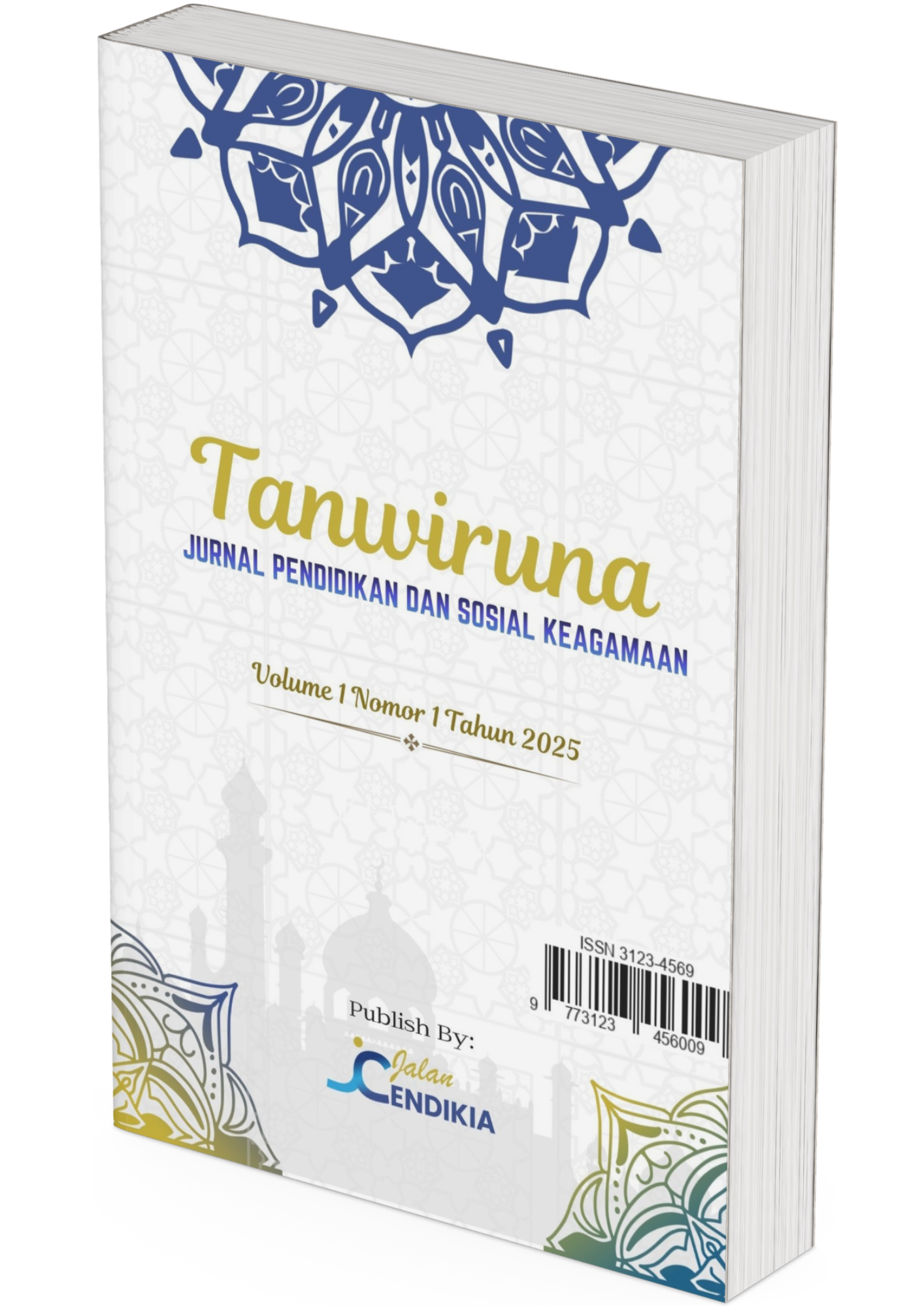
Peran Masjid Al-Anshor dalam Mendakwahkan Islam di Desa Sungai Jeruju Kecamatan Cengal Kabupaten Ogan Komering Ilir
DOI:
https://doi.org/10.65793/j.tanwiruna.2025.20Keywords:
Masjid, Dakwah, Keagamaan, Sosial, MasyarakatAbstract
Penelitian ini bertujuan untuk menggambarkan peran Masjid Al-Anshor dalam mendakwahkan Islam di Desa Sungai Jeruju, Kecamatan Cengal, Kabupaten Ogan Komering Ilir. Masjid tidak hanya berfungsi sebagai tempat ibadah, tetapi juga sebagai pusat pembinaan akhlak, pendidikan keislaman, dan pemberdayaan sosial masyarakat. Penelitian ini menganalisis kegiatan dakwah yang dilaksanakan, peran pengurus dalam mengelola program keagamaan, serta hambatan dan strategi dalam mengoptimalkan fungsi dakwah masjid. Menggunakan pendekatan kualitatif deskriptif, data diperoleh melalui observasi, wawancara mendalam, dan dokumentasi. Hasilnya menunjukkan bahwa Masjid Al-Anshor aktif menyelenggarakan kegiatan seperti kajian fiqih dan akhlak, ta’lim subuh, TPA/TPQ dengan jadwal terpisah untuk anak laki-laki dan perempuan, serta program mengaji bagi orang dewasa dan remaja. Meskipun menghadapi tantangan seperti keterbatasan SDM dan dana, pengurus mampu mengatasi hambatan dengan strategi kreatif dan kolaboratif. Penelitian ini menyimpulkan bahwa Masjid Al-Anshor telah menjadi contoh masjid pedesaan yang adaptif dan progresif dalam menjawab kebutuhan dakwah umat. Keberhasilan ini menjadikan masjid sebagai motor penggerak perubahan spiritual dan sosial di tengah masyarakat.
References
Abu-Ras, Wahiba, Aboul-Enein, Basil H, Almoayad, Fatmah, Benajiba, Nada, & Dodge, Elizabeth. (2024). Mosques and Public Health Promotion: A Scoping Review of Faith-Driven Health Interventions. Health Education & Behavior, 51(5), 677–690. https://doi.org/10.1177/10901981241252800
Ahmed, A., Barot, R., MacKendrick, E. K., Shirazi, F., Blau, J., al-Attas, S. F., Foltz, R., Herlihy, J., Karamihova, U. A. E. M., & Wood, G. (2018). Islamic Perspective. Journal of the Islamic Studies and Humanities, 19.
Bowen, J. R. (2004). Beyond Migration: Islam as a Transnational Public Space. Journal of Ethnic and Migration Studies, 30(5), 879–894. https://doi.org/10.1080/1369183042000245598
Boyd, C. P., & Harada, T. (2022). “Finding home”: Affective geographies of regional youth (im)mobilities. Area, 54(1), 78–87. https://doi.org/https://doi.org/10.1111/area.12749
Cheema, A. R., Scheyvens, R., Glavovic, B., & Imran, M. (2014). Unnoticed but important: revealing the hidden contribution of community-based religious institution of the mosque in disasters. Natural Hazards, 71(3), 2207–2229. https://doi.org/10.1007/s11069-013-1008-0
Creswell, J. W., & Creswell, J. D. (2017). Research design: Qualitative, Quantitative, and Mixed Methods Approaches. Sage publications.
Creswell, J. W., & Poth, C. N. (2016). Qualitative Inquiry and Research Design: Choosing Among Five Approaches. Sage publications.
Flick, U. (2022). An Introduction to Qualitative Research. https://www.torrossa.com/en/resources/an/5409482
Hoelzchen, Y. M. (2022). Mosques as religious infrastructure: Muslim selfhood, moral imaginaries and everyday sociality. Central Asian Survey, 41(2), 368–384. https://doi.org/10.1080/02634937.2021.1979468
Kotani, H., Okai, H., & Tamura, M. (2022). Mosque as a Vaccination Site for Ethnic Minority in Kanagawa, Japan: Leaving No One Behind Amid the COVID-19 Pandemic. Disaster Medicine and Public Health Preparedness, 16(6), 2683–2685. https://doi.org/DOI: 10.1017/dmp.2022.78
Kotani, H., Tamura, M., & Nejima, S. (2022). Mosques in Japan responding to COVID-19 pandemic: Infection prevention and support provision. International Journal of Disaster Risk Reduction : IJDRR, 69, 102702. https://doi.org/10.1016/j.ijdrr.2021.102702
Kuipers, N., Mujani, S., & Pepinsky, T. (2020). Encouraging Indonesians to Pray From Home During the COVID-19 Pandemic. In Journal of Experimental Political Science (pp. 1–12). https://doi.org/10.1017/XPS.2020.26
Kuppinger, P. (2014). One mosque and the negotiation of German Islam. Culture and Religion, 15(3), 313–333. https://doi.org/10.1080/14755610.2014.949054
Lexy J. Moleong. (2013). Metodelogi Penelitian Kualitatif. Remaja Rosda Karya.
Lincoln, Y. S. (1985). Naturalistic Inquiry (Vol. 75). sage.
Matthew B. Miles, A. Michael Huberman, J. S. (2014). Qualitative Data Analysisi A Methods Sourcebook. SAGE Publication Inc.
McLaren, H., Hamiduzzaman, M., Patmisari, E., Jones, M., & Taylor, R. (2024). Health and Social Care Outcomes in the Community: Review of Religious Considerations in Interventions with Muslim-Minorities in Australia, Canada, UK, and the USA. Journal of Religion and Health, 63(3), 2031–2067. https://doi.org/10.1007/s10943-022-01679-2
Mustafa, Y., Baker, D., Puligari, P., Melody, T., Yeung, J., & Gao-Smith, F. (2017). The role of imams and mosques in health promotion in Western societies—a systematic review protocol. Systematic Reviews, 6(1), 25. https://doi.org/10.1186/s13643-016-0404-4
Nurmansyah, M. I., Handayani, S., Kurniawan, D. W., Rachmawati, E., Hidayati, & Alim, A. M. (2022). Congregational Worshiping and Implementation of the COVID-19 Preventive Behavioral Measures During the Re-opening Phase of Worship Places Among Indonesian Muslims. Journal of Religion and Health, 61(5), 4169–4188. https://doi.org/10.1007/s10943-022-01593-7
Oskooii, K. A. R., & Dana, K. (2018). Muslims in Great Britain: the impact of mosque attendance on political behaviour and civic engagement. Journal of Ethnic and Migration Studies, 44(9), 1479–1505. https://doi.org/10.1080/1369183X.2017.1330652
Pérez-Mateo, M., & García-Sánchez, S. (2022). Gamification in Education: A Systematic Review of the Literature. International Journal of Educational Technology in Higher Education, 19(1), 1–18.
Pérez Mateo, M. (2019). The Mosque as an Educational Space: Muslim Women and Religious Authority in 21st-Century Spain.
Sugiyono. (2018). Metode Penelitian Evaluasi (Pendekatan Kuantitatif, Kualitatif, Dan Kombinasi) (1st ed.). Alfabeta, CV.
Westfall, A. (2024). Islamic religious behaviors and civic engagement in Europe and North America. Politics and Religion, 17(1), 138–176. https://doi.org/DOI: 10.1017/S1755048323000263
Downloads
Published
Article Statistics
 97 Views
 38 Downloads
Issue
Section
License
Copyright (c) 2025 Edo, Ayu Munawaroh, Yuniar Handayani (Author)

This work is licensed under a Creative Commons Attribution-ShareAlike 4.0 International License.
 Make a Submission
  Author Guidelines
  Focus and Scope
  Editorial Team
  Reviewer
  Peer Review Process
  Copyright Notice
  Article Processing Charge
  Privacy Statement
  Publication Ethics
  Publication Frequency
  Plagiarism Policy
  Open Access Policy
  Indexing
  Journal History
  Collaboration With

 Template
 TOOLS
TOOLS


 E-ISSN: 3123-4569