Strengthening Anti-Corruption Education Values among Millennials through Community-Based Civic Education: A Community Service Program in Lubuklinggau, Indonesia
DOI:
https://doi.org/10.65793/e-jppkm.2026.104Keywords:
Anti-Corruption Education, Integrity Values, Millennials, Community Service, Civic ResponsibilityAbstract
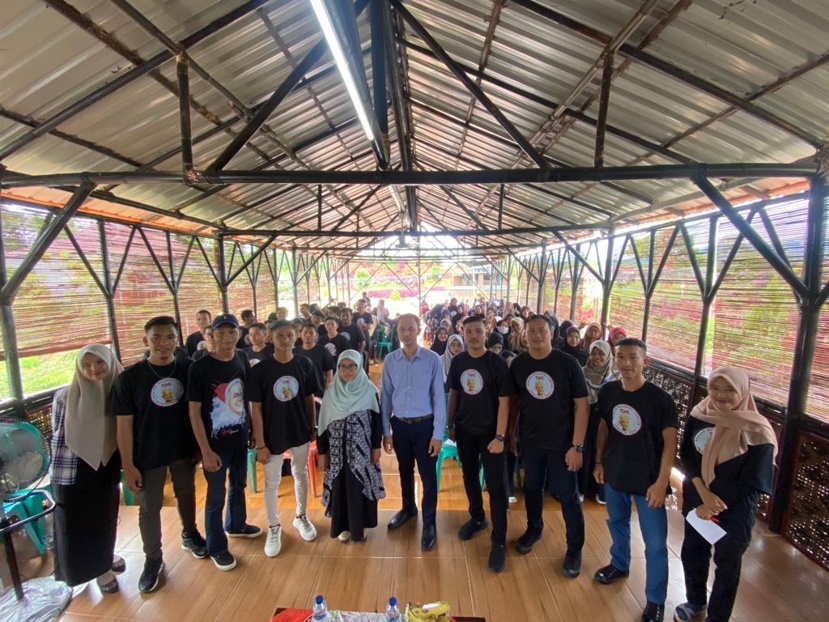
This community service program aimed to strengthen anti-corruption education values among millennials. The program was designed as a qualitative-descriptive community engagement activity through educational outreach, lecture, guided discussion, value clarification, and reflective questioning. The activity was held at IAI Al-Azhaar Lubuklinggau, South Sumatra, and involved students, community members, and anti-corruption activists. The results show that the program strengthened participants’ conceptual awareness of corruption as a legal, moral, and social problem; introduced the nine anti-corruption values as practical guides for everyday behavior; and encouraged dialogic reflection on the causes, risks, and prevention of corrupt practices. The program also provided space for participants to connect anti-corruption values with student life, social organizations, digital spaces, and future professional roles. Although the activity was limited by its one-time implementation, the absence of pre-test and post-test instruments, and incomplete attendance documentation, it offers an initial model of value-based anti-corruption literacy. The implication is that anti-corruption community service programs should be developed continuously, measurably, participatorily, and collaboratively to strengthen youth integrity and civic responsibility.
References
Al-Fayez, D., Hijal-Moghrabi, I., Yoon, Y., & Sabharwal, M. (2024). Building blocks of good governance: Fostering an ethical work climate in public sector organizations. Public Administration and Development, 44(5), 383–396. https://doi.org/10.1002/pad.2054
Alqadri, B., Rispawati, R., Hadi, M. S., Edi, M. G. P., Nurlatifa, N., Sartika, L. D., & Wahyuni, R. (2026). The threat of animated films to national disintegration in the dimension of character formation of the alpha generation: A Study in Mataram City. Jurnal Civics: Media Kajian Kewarganegaraan, 23(1 SE-Original Research Article), 143–157. https://doi.org/10.21831/jc.v23i1.93839
Ardiansyah, S., Anggrawan, A., & Iskandar, D. (2026). Digital citizenship for sustainable development goals: A character-based approach in civic education. Jurnal Civics: Media Kajian Kewarganegaraan, 23(1 SE-Systematic Literature Review (SLR) / Bibliometrics Article), 419–435. https://doi.org/10.21831/jc.v23i1.88912
Brickhill, M., Andrews, G., & Nieuwoudt, J. (2025). Developing Student Agency Towards Academic Integrity Through an Educative Approach: Exploring Students’ Experiences and Perspectives. Journal of Academic Ethics, 23(3), 951–975. https://doi.org/10.1007/s10805-024-09567-y
Cheeseman, N., & Peiffer, C. (2023). Why efforts to fight corruption can undermine the social contract: Lessons from a survey experiment in Nigeria. Governance, 36(4), 1045–1061. https://doi.org/10.1111/gove.12720
Eaton, S. E. (2023). The Academic Integrity Technological Arms Race and its Impact on Learning, Teaching, and Assessment. Canadian Journal of Learning and Technology, 48(2 SE-Notes). https://doi.org/10.21432/cjlt28388
Grigoryev, D., Gallyamova, A., Conway, L. G., Zubrod, A., Sabucedo, J. M., Dono, M., Batkhina, A., & Boehnke, K. (2024). Collective action against corruption in Western and non-Western countries: cross-cultural implications of the Axiological-Identitary Collective Action Model. Frontiers in Psychology, Volume 15-2024. https://www.frontiersin.org/journals/psychology/articles/10.3389/fpsyg.2024.1269552
He, C., Xu, J., & Zhou, L. (2023). Understanding China’s construction of an academic integrity system: A grounded theory study on national level policies. Learned Publishing, 36(2), 217–238. https://doi.org/10.1002/leap.1540
Kamaruddin, M. I. H., Kamarubahrin, A. F., Haron, H., Hanefah, M. M., Ahmad Bustamam, U. S., Ramli, N. M., Mohammad Razali, R., Md Yusof, A. F., & Wook, I. (2025). From Fraud Diamond Theory to the Malaysian National Anti-Corruption Strategy (NACS) 2024–2028. Public Integrity, 1–16. https://doi.org/10.1080/10999922.2025.2554408
Kubbe, I., Baez-Camargo, C., & Scharbatke-Church, C. (2024). Corruption and Social Norms: A New Arrow in the Quiver. Annual Review of Political Science, 27(Volume 27, 2024), 423–444. https://doi.org/10.1146/annurev-polisci-051120-095535
Kwarteng, J. T., & Servoh, M. W. K. (2024). A reasoned action approach to understanding anti-corruption intentions among MBA (accounting) students in Ghana. Heliyon, 10(5). https://doi.org/10.1016/j.heliyon.2024.e26752
Lehtinen, J., Locatelli, G., Sainati, T., Artto, K., & Evans, B. (2022). The grand challenge: Effective anti-corruption measures in projects. International Journal of Project Management, 40(4), 347–361.https://doi.org/10.1016/j.ijproman.2022.04.003
Marquette, H., & Peiffer, C. (2018). Grappling with the “real politics” of systemic corruption: Theoretical debates versus “real-world” functions. Governance, 31(3), 499–514. https://doi.org/10.1111/gove.12311
Mengzhen, L., Sin, Y., Wan Jaafar, W. M., Mohd Khir, A., Hamsan, H. H., Yong, M. H., Wu, S. L., Ooi, P. B., Ong, D. L. T., & Ong, C. S. (2024). Curbing Bribe-Giving in Malaysia: The Role of Attitudes and Parents. Public Integrity, 26(2), 188–202. https://doi.org/10.1080/10999922.2022.2144017
Mengzhen, L., van Oosten, S., & Wan Jaafar, W. M. (2025). Type of Primary School Attended Influences Bribe-Giving Intentions. Public Integrity, 27(4), 471–482. https://doi.org/10.1080/10999922.2024.2353710
Morales-Álvarez, A., Valdés-Cuervo, A. A., & Parra-Pérez, L. G. (2025). Supportive parenting and adolescents digital citizenship behaviors: The mediating role of self-regulation. Cyberpsychology: Journal of Psychosocial Research on Cyberspace, 19(1 SE-Articles), Article 2. https://doi.org/10.5817/CP2025-1-2
Moriarty, C., & Wilson, B. (2022). Justice and Consistency in Academic Integrity: Philosophical and Practical Considerations in Policy Making. Journal of College and Character, 23(1), 21–31. https://doi.org/10.1080/2194587X.2021.2017971
Mungiu-Pippidi, A., & Johnston, M. (2017). Transitions to Good Governance: Creating Virtuous Circles of Anti-corruption. Edward Elgar Publishing Limited. https://books.google.co.id/books?id=H7MzDwAAQBAJ
Perkins, M., & Roe, J. (2024). Decoding Academic Integrity Policies: A Corpus Linguistics Investigation of AI and Other Technological Threats. Higher Education Policy, 37(3), 633–653. https://doi.org/10.1057/s41307-023-00323-2
Prasetyo, H. (2026). Strategi Inovatif Odd One Out dalam Materi Pronunciation di Sekolah Dasar. In Edupro: Jurnal Pendidikan dan Pengabdian Kepada Masyarakat (Vol. 1, Issues 1 SE-Articles, pp. 56–65). https://doi.org/10.65793/j.e-jppkm.2025.36
Srirejeki, K., & Khairurrizqo, K. (2025). The role of community engagement as corruption control strategy in local governments: insights from Indonesia. International Journal of Public Sector Management, 38(7), 872–894. https://doi.org/10.1108/IJPSM-12-2024-0407
Takacs Haynes, K., & Rašković, M. (Matt). (2021). Living with Corruption in Central and Eastern Europe: Social Identity and the Role of Moral Disengagement. Journal of Business Ethics, 174(4), 825–845. https://doi.org/10.1007/s10551-021-04927-9
Wijaya Mulya, T., Aditomo, A., & Suryani, A. (2022). On being a religiously tolerant Muslim: discursive contestations among pre-service teachers in contemporary Indonesia. British Journal of Religious Education, 44(1), 66–79. https://doi.org/10.1080/01416200.2021.1917338
Zhang, W., Chen, Z., Chia, Y.-T., & Neoh, J. Y. (2022). Rethinking civic education in the digital era: How media, school, and youth negotiate the meaning of citizenship. International Communication Gazette, 84(4), 287–305. https://doi.org/10.1177/17480485221094
Downloads
Published
Article Statistics
 15 Views
 6 Downloads
Issue
Section
License
Copyright (c) 2026 Heru Prasetyo (Author)

This work is licensed under a Creative Commons Attribution-ShareAlike 4.0 International License.
 Make a Submission
  Author Guidelines
 Editorial Team
  Reviewer
  Peer Review Process
  Copyright Notice
  Article Processing Charge
  Privacy Statement
  Publication Ethics
  Publication Frequency
  Plagiarism Policy
  Open Access Policy
  Collaboration With
 Template
 E-ISSN
 TOOLS
TOOLS